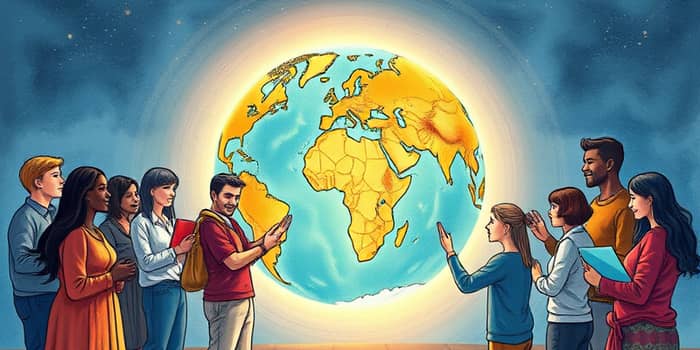
Charitable giving has evolved into a powerful engine for transformation, moving vast sums and diverse resources worldwide.
From monetary donations to volunteering time, the ripple effects of generosity shape lives and communities across the globe.
In 2024, U.S. donors contributed a record $592.50 billion, reflecting robust economic growth and sustained philanthropic commitment.
Individuals accounted for two-thirds of that total, foundations and corporations also set new highs, and bequests remained a vital legacy channel.
Across sectors, religious organizations received $146.54B, human services $91.15B, and education hit an all-time high even after inflation at $88.32B.
International affairs saw a 17.7% surge to $35.54B, demonstrating impactful cross-border philanthropic outflows that complement development aid and private investment.
Movements like GivingTuesday further illustrate the breadth of generosity. In 2025, Americans donated $4.0B in a single day, with 38.1 million participants giving money, goods, and voice.
Philanthropy transcends checks in the mail. Modern donors embrace emerging impact investing and crypto gifts, expanding the definition of charitable resources.
Donor-advised funds (DAFs) are central to this shift. In 2024, Fidelity Charitable donors recommended $14.9B in grants, a historic high and $3B growth year-over-year.
Over 350,000 individuals leverage the Fidelity Charitable donor-advised fund ecosystem to give strategically, with noncash contributions like $786M in cryptocurrency and $15.5B in private assets fueling global causes.
Tax-free investment growth within DAFs has unlocked an additional $30B for nonprofits, underlining the multiplier effect of time, skills, crypto, impact investing and traditional giving.
Why do people give? The answer spans altruism to legacy, but certain themes endure across cultures and income levels:
The World Giving Index consistently shows that participation rates often peak in lower-income countries, highlighting the profound role of cultural and social norms in shaping generosity behaviors.
Despite its benefits, philanthropy faces criticism. Donor concentration risks overshadow grassroots voices, while administrative costs sometimes dilute impact.
Ethical debates arise over large gifts driving agendas or perpetuating unintended colonial or paternalistic pitfalls in vulnerable regions.
Transparency and accountability are crucial. Donors and nonprofits must collaborate to streamline operations, reduce overhead, and ensure resources reach intended beneficiaries.
Innovations like blockchain tracking and participatory grantmaking offer pathways to build trust and empower local stakeholders in decision-making.
Every individual can play a part. Consider these guidelines to maximize your charitable footprint:
By following these steps, donors can move beyond impulse giving to a sustainable, strategic approach that amplifies their impact over time.
Charitable giving is more than a transaction: it’s a promise to future generations. When driven by empathy, guided by data, and executed with integrity, your contributions can transform communities, safeguard the planet, and forge a more equitable world.
Embrace the power of your resources today—money, time, expertise, and voice—and become a catalyst for global change.
References