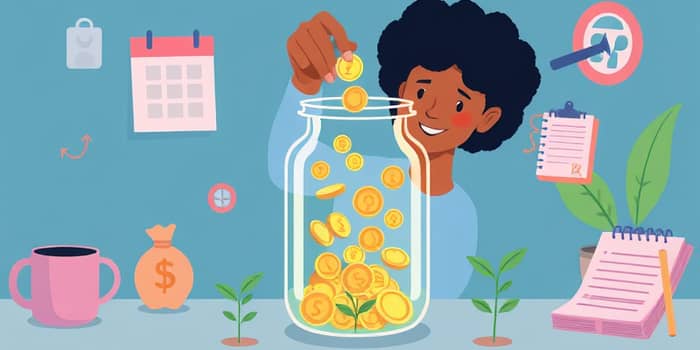
In a world where financial headlines often spotlight dramatic market crashes and sweeping policy shifts, many people feel overwhelmed and powerless. Yet, the path to financial resilience does not require grand gestures—it thrives on simple, everyday decisions. By starting small today, you can cultivate habits that lead to profound transformation and lasting security.
Despite the persistent rise in living costs and daily financial pressures, building an emergency buffer is within reach. Federal Reserve data from 2024 reveals that 55% of U.S. adults have at least three months’ worth of expenses saved. While that highlights a success story for some, it also underscores that nearly half of households remain vulnerable to unexpected events such as medical bills, car repairs, or job disruptions.
Research from Vanguard shows that just about $2,000 in liquid savings dramatically reduces the likelihood of financial distress and enhances overall well-being. However, surveys indicate that 63% of households cite inflation as the primary reason for reduced savings, proving that psychological barriers often outweigh informational gaps. The key message: you can’t fix inflation still rings true, but you hold the power to refine your spending choices. By embracing small, repeatable choices that compound, you carve a clear and achievable route toward stability.
Embarking on a savings journey begins with identifying manageable actions that slot seamlessly into your daily routine. The following strategies are proven to drive real results without demanding drastic lifestyle changes.
Imagine replacing one takeout meal with a home-cooked dinner each week. Even if you save only $10 per outing, that translates to $520 annually. Thanks to the power of compounding, a 3% annual return can amplify these modest contributions into a nest egg worth almost $13,000 over two decades. This simple trade-off between convenience and foresight showcases how consistent behaviors yield exponential benefits.
Subscriptions may feel harmless at first, but they can quietly drain your budget. By reevaluating one $15 monthly service—be it a streaming platform or a specialty app—you recapture $180 each year. When you funnel these funds into a Roth IRA or other tax-advantaged account, the long-term rewards can be astonishing, potentially growing into a six-figure cushion when combined with regular contributions and market gains.
Many banks now offer round-up tools that transfer the spare change from each purchase into a savings or investment account. If your average daily roundup sits at around $1, you’ll accumulate approximately $360 in twelve months. With a consistent 5% return, this modest approach can lead to about $12,000 in twenty years, all without changing how you shop or spend.
By prioritizing the pay yourself first principle, you avoid the common trap of saving what is left over after all other spending. Automating $100 from each biweekly paycheck ensures $2,600 goes into your savings every year. With just a 3% annual growth rate, you could transform those automatic deposits into nearly $70,000 over twenty years, illustrating that timing and discipline often outpace sheer contribution size.
Impulse buying can erode budgets through seemingly innocuous purchases. Instituting a simple 24-hour delay rule before completing any non-essential online purchase can prevent roughly $600 in annual waste. Invest those avoided expenses at a conservative 5% growth rate, and within twenty years you may find your discipline rewarded with a balance close to $20,000. This habit cultivates mindfulness and demonstrates how introducing minimal friction can protect your resources effectively.
Small actions yield the greatest impact when woven into the fabric of everyday life. The concept of habit stacking definition: pairing a new habit encourages you to attach a savings behavior to an existing routine. This approach eliminates decision fatigue and makes the new habit feel natural.
Each time you sip your first cup, open a budgeting app to categorize recent transactions. Soon, this five-minute ritual becomes as automatic as your caffeine fix. Similarly, combining a quick, annual call to negotiate bills with a personal occasion—your birthday or anniversary—can secure loyalty discounts and trim recurring costs by hundreds of dollars each year.
Leverage features like automatic transfers and round-ups to embed a layer of automation and low-friction behavior into your financial life. Once set up, these systems work invisibly, ensuring you save before you spend and reinforcing momentum without the need for constant attention.
As these micro-habits take hold, shift your focus toward broader financial milestones. Start by targeting a starter emergency fund of $500 to $2,000, then aim for at least three months of living expenses. Beyond that, chart a path to six months or more based on your comfort level and risk tolerance. By breaking this journey into defined stages, you maintain motivation and celebrate each milestone.
Tracking your expenses remains a cornerstone of long-term success. Data consistently shows that people who monitor every purchase end up saving saves three to ten times more than those who ignore the details. With heightened awareness, you’ll uncover “hidden leaks” such as underused memberships, unnecessary fees, or recurring services that no longer align with your goals.
Your long-term vision need not be a distant dream. Today’s small decisions lay the groundwork for tomorrow’s triumphs. Whether you’re working toward a down payment, building a college fund, or planning for a comfortable retirement, each dollar you redirect now accelerates your progress. Trust in the compounding power of consistency, and remember that the journey to financial freedom is a marathon, not a sprint.
Embark on this adventure with patience and curiosity. Celebrate every small victory, refine your strategies as you learn, and lean on supportive communities or tools when you need inspiration. The road to resilience is paved with countless tiny steps, each one carrying you closer to security, opportunity, and peace of mind.
Take that first step today. Your future self will look back with gratitude for the momentum you set in motion with these modest yet mighty changes.
References