2025 has tested the resilience of investors around the globe, as market fluctuations have become the defining feature of this year’s investment landscape. From trade policy shockwaves to geopolitical flashpoints, the volatility we’ve witnessed is more than noise—it’s a catalyst for bold decision-making and strategic positioning.
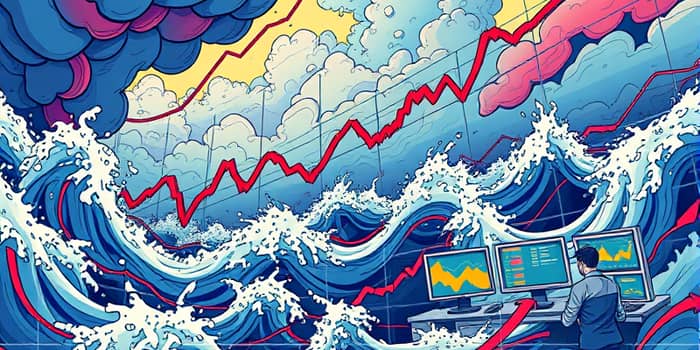
The U.S. equity market has experienced an double-edged sword of volatility, with the CBOE Volatility Index (VIX) averaging 20.8 year-to-date. This level eclipses six of the past eight years, ranking behind only the crises of 2020 and 2022.
In early April, the VIX spiked to 60.1 after sweeping tariff announcements ignited fears of a global trade war. The S&P 500 concurrently plunged 12.9% in a single week—both moves landing in the 99.9th percentile of historical fluctuations. These seismic shifts underscored how rapidly sentiment can swing when certainty evaporates.
Volatility in 2025 has been fueled by a confluence of factors, each interacting in unpredictable ways. Understanding these drivers is essential for crafting adaptive investment strategies.
Although volatility poses risks, it also opens doors for those prepared to act decisively. By embracing market turbulence, investors can identify entry points and protect capital.
Hedging strategies such as put options or inverse ETFs provide additional layers of protection when markets whip about. Global diversification further reduces the impact of region-specific shocks, smoothing overall returns.
Leading analysts highlight parallels between spring 2025 and previous periods of heightened uncertainty. The St. Louis Fed attributes the turmoil to swiftly changing expectations around tariffs, trade, and economic policy. Meanwhile, J.P. Morgan notes that the speed and aggressiveness of real-world tariff implementation far exceeded consensus forecasts.
Fidelity warns that sticky inflation and budget negotiations remain persistent volatility catalysts. Natixis underscores the combination of abrupt trade policy shifts and looming Fed rate decisions as drivers of continued market turbulence. As one volatility specialist remarked, there is no shortage of catalysts for volatility in the latter half of the year.
Market turbulence demands a disciplined approach. Investors should consider the following principles to thrive in uncertain times:
Adhering to these tenets, investors can transform volatility from a crippling force into a source of opportunity and potential outperformance.
As we look toward the second half of 2025, persistent themes are likely to shape the market environment. Ongoing trade negotiations, fiscal policy debates, and evolving geopolitical hotspots will keep uncertainty elevated. Yet history has shown that lessons from past financial crises can guide decision-making under stress.
With volatility remaining above long-term averages, nimble investors should remain vigilant for windows of opportunity. By focusing on fundamentals, managing risk proactively, and retaining a long-term perspective, it becomes possible to harness the disorderly forces of the market.
Ultimately, volatility is not a barrier—it’s a signal. It alerts us to moments when fear has driven prices below intrinsic value or when exuberance has propelled them too high. By interpreting these signals and acting with conviction, investors can pursue long-term asset accumulation at lower prices and emerge stronger when calmer waters return.
References