Financial habits begin early, and equipping children with money skills lays the foundation for responsible adulthood. From coin recognition to understanding credit, parents and educators can close gaps left by uneven school curricula.
In this guide, we explore why money lessons matter, what core concepts every child needs, and practical strategies to teach at each stage of development. Armed with data, evidence-based activities, and inspiring narratives, you can transform everyday moments into powerful financial learning experiences.
Despite staggering investments in education—nearly $857.2 billion annually in K–12 public schools—personal finance remains underemphasized. A national survey found that 87% of U.S. consumers think financial concepts belong in high school, and 72% believe they should start even earlier, in middle school. Yet less than half of high schoolers have formal classes.
Shrinking public support intensifies the need for home-based education. With only 8.57% of federal spending supporting children and rising family economic pressures, parents must fill the gap by teaching practical money skills. Early lessons about earning, saving, and spending shape long-term behaviors, reduce debt risk, and foster generosity.
Research also highlights a ripple effect: when children learn money management, their families often adjust spending and saving habits too. This intergenerational impact can reshape household finances for the better, making early financial education a catalyst for broader change.
Tailoring lessons to developmental stages ensures children grasp concepts concretely. Below is an age-by-age roadmap with activities you can implement at home.
At this stage, children benefit from sensory experiences with coins and observing money exchanges. The goal is awareness, not arithmetic.
Focus on the simple distinction between needs (food, clothing) and wants (toys). Reinforce that if coins are gone, purchases pause.
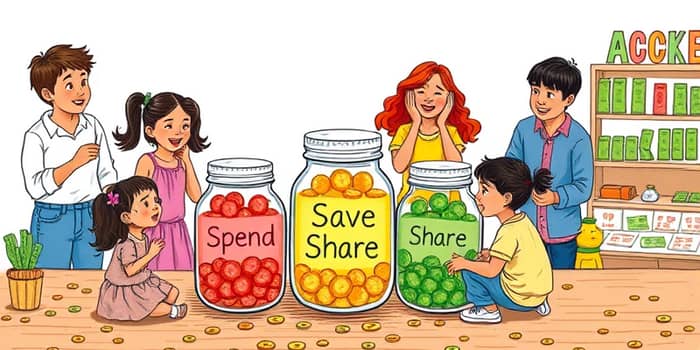
Children now grasp basic choices and trade-offs. Introduce three jars or envelopes for Spend, Save, Share and small amounts of money for birthdays or simple chores.
By linking effort to rewards, children learn that money is finite and that planning yields better outcomes. Celebrating when they share fosters generosity and social awareness.
Elementary-aged kids can handle structured tasks. A weekly allowance becomes a tool for real lessons in choice and consequence.
Let them make harmless mistakes—like spending all their allowance on a low-quality toy—and discuss what they’d do differently next time. This fosters critical thinking and self-reflection.
Preteens are ready for deeper concepts: opportunity cost, planning ahead, and understanding that digital purchases have real value.
Discuss goal setting: saving for a new bike or gadget, charting progress visually. Tie chores or neighborhood jobs to earning beyond allowance, reinforcing that additional effort brings extra rewards.
As teenagers approach adulthood, introduce credit scores, loan interest, and compound growth. Simulated experiences deepen understanding.
Discuss student loans and scholarship strategies to underscore the long-term impact of early saving. Show how a $1,000 investment at age 16 can grow substantially by retirement, illustrating the magic of compound interest.
Consistency and conversation are the linchpins of success. Integrate money talk into daily routines—grocery shopping, bill payments, and family vacations all offer teaching moments.
Celebrate milestones: first deposit into a savings jar, a completed budget worksheet, or the joy of giving part of their money to a cause they care about. Positive reinforcement cements good habits.
Finally, lead by example. Share your own budgeting app screen, discuss financial decisions openly, and admit to mistakes you’ve made. Demonstrating transparency builds trust and shows that money management is a lifelong learning process.
By investing time and creativity now, you empower your children to navigate complex financial landscapes with confidence and compassion. These practical lessons will serve them—and your family—well for decades to come.
References