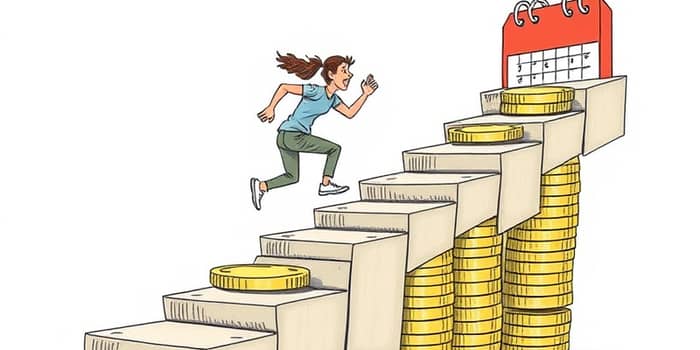
Imagine treating your next financial milestone like the most important project at work: short, intense bursts of focus, daily check-ins, and crystal-clear targets. That is the power of a savings sprint—an Agile-inspired approach designed to supercharge your progress.
What if you could shatter overwhelm and transform vague ambitions into tangible wins in just weeks? By borrowing principles from software teams, you can craft short, intense, highly focused period where every dollar counts toward your goal.
Long-term goals often feel daunting. A 10-year savings plan can drain motivation and breeding uncertainty. Yet, when you compress your objective into a 30- or 60-day challenge, you harness urgency, clarity, and momentum.
Vague intentions like “I should save more” rarely survive lifestyle creep, while a sprint’s structure removes friction. Instead of vague hope, you adopt crystal-clear goals and daily tracking, forging a path from intention to achievement.
A savings sprint is a time-boxed period where you commit to a single, clear financial target. Usually lasting two to six weeks, each sprint focuses on one metric—dollars saved, debt repaid, or savings rate increased—without distractions from additional side projects.
Key parallels to Agile sprints include:
By reframing personal finance in these terms, you gain the same benefits Agile teams enjoy: sharper focus, visible progress, and frequent celebrations of success.
Ready to launch your first savings sprint? Follow this proven framework:
This structured cycle fosters accountability and transparency, ensuring that small wins accumulate rapidly into significant progress.
Think of tactics as backlog items you can pick and choose. Below are practical, high-impact moves to drive your sprint.
Even a temporary sprint that doubles your monthly savings from $200 to $400 yields an extra $600 in three months. If you repeat two sprints a year, that’s an additional $1,200 annually—money that compounds over time.
Tracking progress isn’t just about accountability: it fuels motivation. Use a simple chart or spreadsheet to plot remaining savings against time. This visual frequent wins from small completed goals amplifies satisfaction and keeps momentum high.
Beyond immediate gains, short-term bursts can lift your baseline savings. Consider investing at a 7% annual return: saving $300 monthly for ten years grows to approximately $51,000. If a sprint lifts your contribution to $400 per month permanently, your 10-year haul jumps to around $68,000—an extra $17,000 from a single mindset shift.
After each sprint, conduct a retrospective: celebrate successes, analyze challenges, and adjust your plans. Perhaps certain tactics were too restrictive, or maybe you discovered a new side hustle that consistently brings in extra cash.
Use these insights to set your next sprint goal. Over time, this iterative cycle fosters a habit of continuous improvement. With each short, relentless push, you build confidence and increase your financial runway.
Long-term transformation doesn’t require ten years of unbroken discipline. It takes a series of well-defined, focused sprints that harness human psychology and Agile rigor. By adopting this approach, you replace overwhelm with clarity, inertia with momentum, and vague aspirations with measurable victories.
Your next savings sprint is waiting. Define your goal, plan your actions, and commit to daily progress. In just weeks, you’ll look back amazed at how far you’ve come—and ready to sprint toward the next milestone.
References